BBVA Hung Up on Me. That Is the Design.
Two rejected cards, one AI phone tree, and the realization that the hang-up was the point.
TL;DR
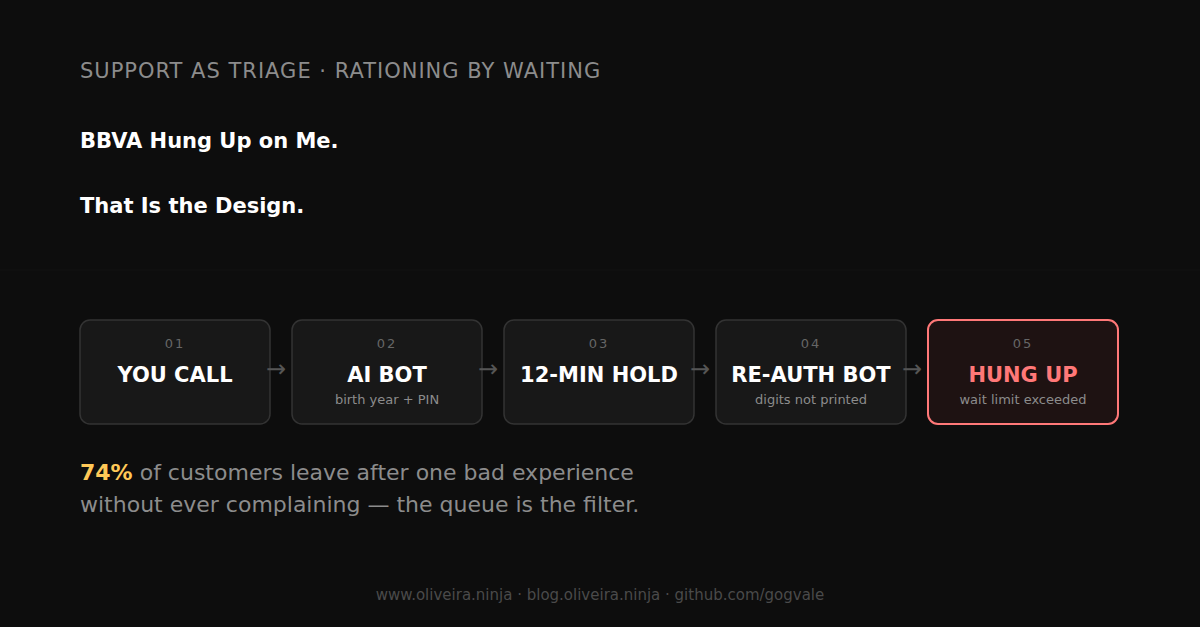
- Both my cards got blocked buying a $2 domain. The bank’s help line was an AI bot, a 12-minute hold, then a re-authentication bot that hung up on me.
- That is not a bug. Support automation is triage: the goal is not to help everyone, it is to make you complain as little as possible and then give up.
- The data agrees: 74% of customers leave after one bad experience without ever complaining, and a federal report on bank chatbots calls this exact situation “stranded.”
- The fix is not a friendlier bot. It is treating support as the cost of keeping a customer.
The cards
I bought a domain at Porkbun — a store I have used before, one that worked fine — and both my cards got blocked. That is normal enough: banks block unusual purchases for security, and you fix it by calling the line. So I called.
The line picked up with an AI that asked me to describe my problem. Fine. It asked for four digits of my birth year and the last two digits of my PIN — the “something only you know” dance.
I failed the first time because I mixed up my own PIN, which I normally type from muscle memory. I had to stop and think. It worked on the second try.
Then I waited. Twelve minutes of “there are no agents available.” A Sunday at 5pm, so a short wait is fair — except that when the machine finally made an outgoing-call beep, it was not an agent.
It was another bot, asking me to re-authenticate: the last four digits of my card and the last two of its PIN.
I do not know the last four digits of my physical card. Nobody does — they are not printed on the card anymore. So I typed the digits from the digital card in the app. Denied. Twice.
While I dug through my password vault, the voice kept telling me it had not received an answer, and to press 1 to wait a little longer.
After three “wait a moment”s it told me the wait limit was exceeded, said goodbye, and hung up.
The hang-up is the feature
Here is the part that is not an accident. Cory Doctorow’s word for it is enshittification — platforms degrade toward their own users to save money, one squeeze at a time. A support line is a cost center, and the cheapest customer is the one who stops calling.
The re-authentication loop was not there to help me. It was there to make me fail, get tired, and give up. And it worked. I hung up with the card still blocked and a new plan — PayPal, which I do not like — because the alternative was more phone tree.
This is triage, and it is not for you
Compare it to emergency-room triage. The word is honest about what it does: triage comes from the French trier, “to sort” — when more patients arrive than there are beds, somebody decides who is seen first.
Health economists have a name for the uglier version: rationing by waiting. The queue becomes the filter. The people who can wait, wait; the people who give up, leave.
Hospitals even measure the ones who walk out, as left without being seen, and they spend money trying to make that number smaller.
Customer support runs the same queue, minus the part where anyone tries to make the number smaller. A 2026 Avaya survey found 74% of consumers stopped doing business with a company after one bad experience — without ever complaining.
Silence is the point. A customer who gives up quietly costs nothing; a customer who complains needs a human, and humans cost money.
The Consumer Financial Protection Bureau has a report on my exact situation — chatbots in consumer finance, and what happens when a broken bot is the only option for time-sensitive help: “it may leave people stranded”. Stranded. Not “served slower.” Stranded.
And the banks are not hiding the math. An industry report puts the cost savings per chatbot interaction at 72 cents, with resolution times down 38%. Every call the bot eats is money the bank keeps. The frustration is not a side effect of the cost cutting. It is the mechanism.
The part that stings
The survey data even shows the frustration is growing: in 2026, more customers said they would hang up the moment they heard an AI on the line — up from 29% to 31% — and 59% are frustrated with AI agents.
But the bank does not mind if I hang up. I already hung up. The bot won.
The tell is the re-authentication. A human would never ask me for digits that are not printed on the card.
A machine asks, because it does not know or care that I cannot answer — it is a filter wearing a phone.
The last two digits of a PIN, from a card I cannot read, after twelve minutes of hold: that is not security. That is a wall built to make me stop.
“That is not security. That is a wall built to make me stop.”
The fix is not a friendlier bot. It is for a bank to treat support as the cost of keeping a customer, and not as a line item to shrink until people stop calling.
I will believe BBVA wants to help when the phone line’s first question is “what happened” from a person, not a birth year from a machine.