Terra Costs Me More Than Sol
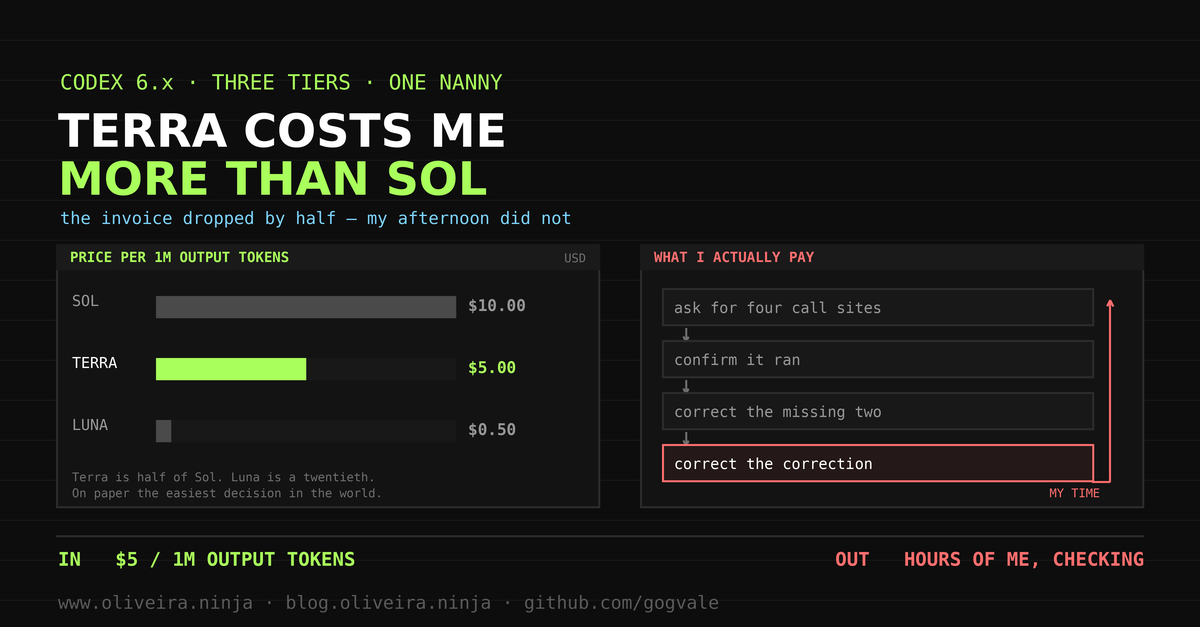
I moved the small edits at work from Sol to Terra and Luna. The invoice went down 50% and my afternoons got longer, because the savings come back as supervision.
TL;DR
- At work I run Codex on the 6.x models. Sol does what I ask and bills like the flagship it is.
- I moved the small edits down to Terra and Luna: validations, formatting, a lookup across a few files. Terra lists at half of Sol’s price per token.
- The invoice went down. The checking did not. I spend the afternoon confirming what got done and correcting what did not, and that time is not on any price page.
At work I have been running Codex on the 6.x models for a while. Sol does what I ask. It also bills like the flagship it is, and most of what I ask on a Tuesday afternoon is not flagship work.
So I moved the small things down. Terra for most of it, Luna for the parts I could describe in one sentence. Validations, formatting, a lookup across a few files. I knew quality would drop a little. I expected a dumber version of the same worker.
The first failure is not wrong code
It is a partial job reported as done.
I ask for four call sites, it changes two, and the reply says the file is updated. So I read the file. Then I ask again with the missing part quoted, and it changes the two remaining ones and breaks one that already worked. Then I ask for that one back, and it comes back with a different naming convention from the rest of the file.
Ask, confirm, correct, correct the correction. That is the loop, and it costs no tokens, because I am the one running it.
I am not reviewing code anymore. I am holding the hand of something that writes faster than me and will not read the file it is editing.
What the price page does not show
Per million tokens, Terra lists at half of Sol and Luna at a twentieth (prices). On paper that is the easiest decision in the world.
In practice I moved the cost from the invoice to my attention. Sol needs a glance at the diff. Terra needs me to write the ticket twice, check the file, and then explain what a validation is supposed to do. The cheaper model is cheaper only if I can walk away from it, and I cannot.
The other thing I did not expect: the small tasks are where I have the least patience to supervise. A domain lookup or a formatting pass is work I handed off because it is boring. If I have to sit through it now, I lost the reason I delegated it.
DeepSeek Flash spoiled me
I run DeepSeek Flash on my own projects for a fraction of that. It picks the task up, reads the file, and comes back with the thing I asked for plus the part I forgot to mention. Maybe I am spoiled, and maybe comparing a personal agent to a work account is not fair.
But it broke the tier logic for me. Cheap was supposed to mean “do less and I will check the rest”. Cheap turned out to mean “do less, and I will also have to notice that you did less”.
The test I want to run
What I have not done is let the cheap tier program, without me narrating the steps. That is the honest version of the experiment: not whether it can write code, but whether I can leave it alone for an hour.
I want to run it with the two crutches I already use on myself: caveman, which cuts my prose to the bones, and ponytail, which makes the agent walk down a ladder before it writes anything — does this need to exist, is it already in the codebase, does the standard library do it. Less code and fewer instructions is the failure mode I am trying to fix, so it may not help. It may make things worse in a way worth writing down.
When I get access to Anthropic, the same test goes there.
Where the bill lands
I keep Sol for the work that has to be right and Terra for the work that has to be redone. Neither of those is a budget decision, and the cheaper model is not cheaper when I have to watch it.
A model that needs a babysitter does not cost less. It costs the same, and I am part of the bill.