Cheapest Tokens Ever, Biggest Buildout Ever
Who actually gets paid when token prices collapse and AI capex explodes.
TL;DR
- Token prices hit record lows while AI infrastructure spending hits record highs — same quarter.
- Three ways the money comes back: volume, shovels, or moving up the stack.
- The buildout already has its answer. The token sellers are still waiting on theirs.
The discussion that started it
I was watching a discussion about AI token prices, and one number kept coming back: DeepSeek charges about 28 cents for the same output that costs $25 on Opus — a 99% discount. I pay for tokens myself every month, so the number stuck.
The usual camps showed up anyway: the ones who said it proves AI is a commodity now, the ones who said it proves the whole thing is a bubble, and the ones arguing about whether anyone is actually making money.
Nobody could answer the obvious follow-up.
The other side of the argument is the big cloud providers are on track to spend somewhere between $600 billion and $800 billion this year on AI infrastructure — the physical stuff: server buildings, chips, power plants.
To make that number real: even at the low end it is more than the entire economy of Sweden. It works out to close to a hundred dollars for every person on the planet. The money is moving at somewhere between seventy and ninety million dollars an hour, every hour, all year.
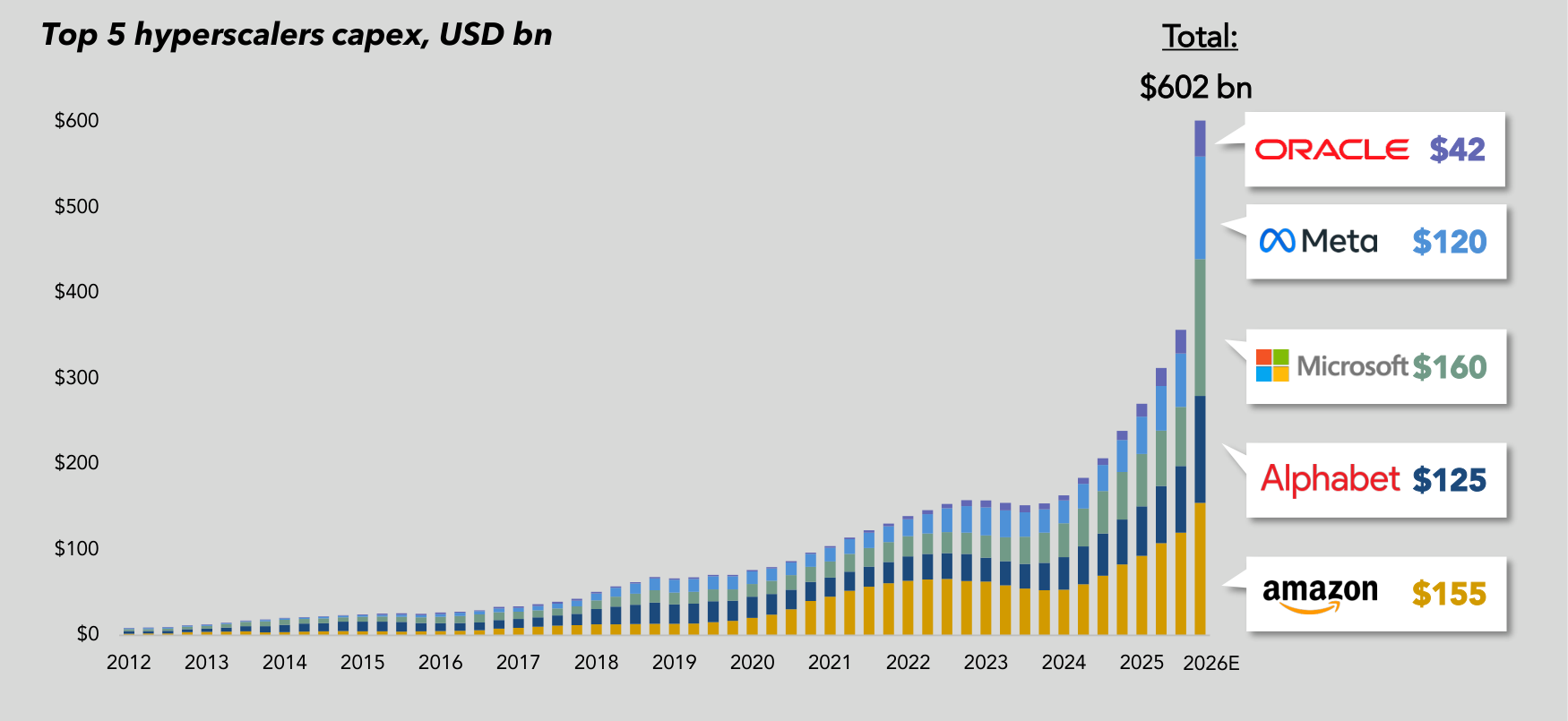 Source: MUFG Capital Markets Strategy — top-5 hyperscaler capex, 2015-2026E. Forecast $602 Bn for 2026, +36% over 2025.
Cheapest intelligence ever sold. Biggest bet ever placed. Same quarter.
That math does not work unless somebody has a plan. So I started thinking about who gets paid.
The bakery
The first answer is volume. Sell tokens cheap, sell more tokens. It worked for everything else that got cheap — storage, bandwidth, compute all followed the same curve. Prices collapse, usage explodes, and the total bill keeps growing. Economists have a name for it: Jevons paradox.
The price war is already in motion. DeepSeek’s cut forced OpenAI, Google, and Anthropic to slash their own API prices. That is the volume thesis in real time.
The wrinkle is that businesses do not eat unlimited tokens like consumers eat unlimited video. A streaming subscriber watches until bedtime. A company stops paying for output the moment the output stops paying for itself.
Volume has to outrun the price cut, and the customer’s appetite has a ceiling. Maybe it does. Maybe it does not.
The gold rush
Nobody remembers the miners’ names. The people who got rich sold the jeans, the picks, and the claim maps.
The buildout is real money. Chips, racks, power plants, buildings — that money lands before a single token sells. It lands in a handful of names before it lands anywhere else: the chipmakers, the rack vendors, the power plays.
The companies building the infrastructure do not need the AI bet to pay off. They need the bet to keep being placed. If the whole thing goes sideways tomorrow, the shovel sellers already banked five record years.
The capex is not a bet on AI. It is the product.
The streaming lesson
When every service had the same movies, the money stopped following the movie and started following the bundle. Tokens are becoming the same movie.
Frontier models converge, open weights undercut the rest, and raw intelligence turns into a commodity nobody makes a margin on. PNC’s economics desk says it plainly: open-weight models are closing the gap, and the model layer risks commoditization.
The survivors will be the ones selling the outcome — agents, workflows, subscriptions that do a job — not the raw intelligence underneath. I have written about the buyer side of this before. This is the seller side.
Keeping score
Three theories. I do not know which one wins, and I trust anyone who tells you they do about as far as I can throw their benchmark.
But each theory predicts something I can check. If volume wins, token usage curves keep climbing and the labs keep growing revenue. If shovels win, the infrastructure names stay rich while the labs fight over scraps. If the stack moves up, the labs quietly stop selling tokens and start invoicing for outcomes.
The buildout’s math closes either way. The token sellers are the ones still waiting on theirs.