You're the Only One Using AI
Most people use AI for memes and homework. The half that uses it to work faster produces the same work as everyone else. The panic is the loudest part, and the numbers do not back it.
TL;DR
- Half of U.S. adults use a chatbot, one in four uses one every day, and most of that use is search, homework and memes. The gap is not access, it is what people ask for.
- Two in three say AI is moving too fast, and most AI users say they fear falling behind. The share that is ahead is one in five.
- The users who go deep produce work that looks like everyone else’s. That part is real, and smaller than the panic around it.
A thread on a technology forum this week said what I had been circling all month: the poster expected everyone his age to be an AI expert by now, and found that almost nobody is. Homework, quick questions, an image now and then. He meant it as a complaint. I read it as the useful part, because the surveys agree and nobody believes them.
Here is my version of his week. I spent an afternoon on a vulnerability report with Claude. The work was not in the writing: I told it who the report was for, which finding mattered most, and what the reader would do with it. The draft came back with two features I had not asked for, both useful, one of which made it into a presentation the next day.
The next day I saw a template from someone else that looked almost identical to what I had built. Same shape, same order, same summary table at the top. Then, walking home, the food carts: poster after poster in the same yellow, the same over-detailed photos, the same font that has no name. None of them was copied from another. They were all copied from the same place.
The Dabblers
Half of U.S. adults use a chatbot, and a quarter of them use one every day. The reasons are narrow: searching for something, tasks at work, a bit of fun, images and video. About a fifth of Americans have never touched one at all. Most people stop developing on the second day: they find the three things it does well for them and keep asking for those. The photos of the 80s, the summary of the meeting, the email that needed to sound firmer than it was.
The Power Users
The middle group is the largest. These are people who open the tool at work every day, and it does what they were promised: they ship more, faster. Then the pile grows of work that came out of the same machine.
Coworkers can tell. In a 2026 survey of 2,000 workers, most said they look harder at a document when they know AI helped write it, and close to half have had to redo someone else’s. The speed was real; the sameness was the hidden part of the invoice.
The Frontier
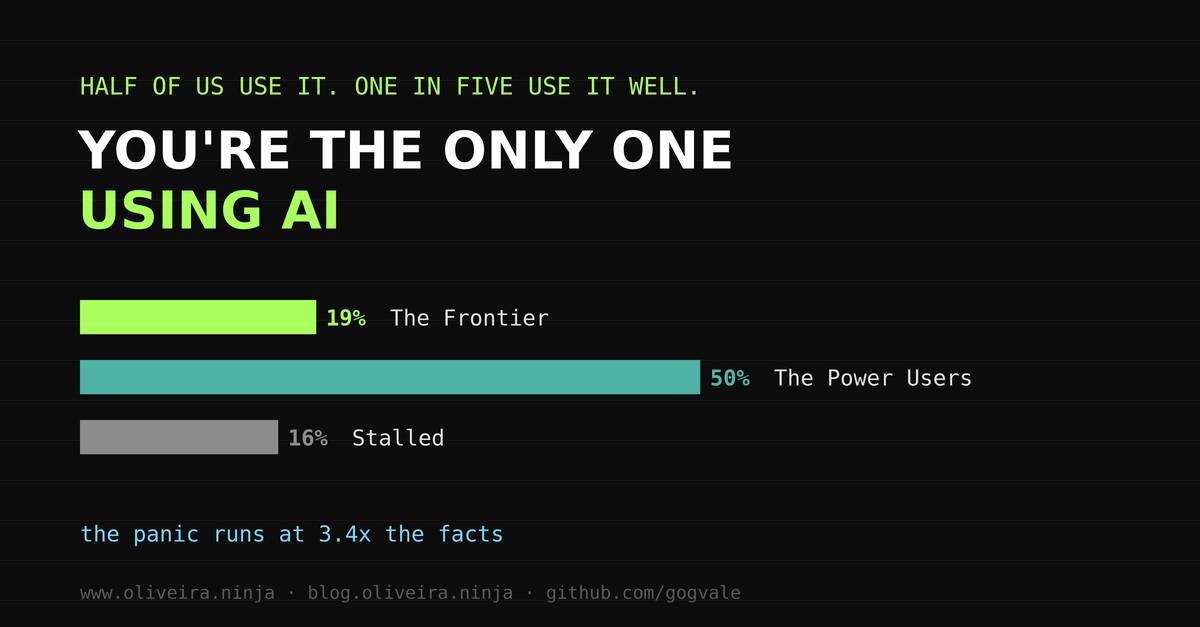
One in five. Not smarter, and their own survey answers say so: they are far more likely to have a manager who uses the tool in the open, a team with standards for what good AI-assisted work looks like, and a workplace that rewards redesigning the work even when the outcome is still unclear.
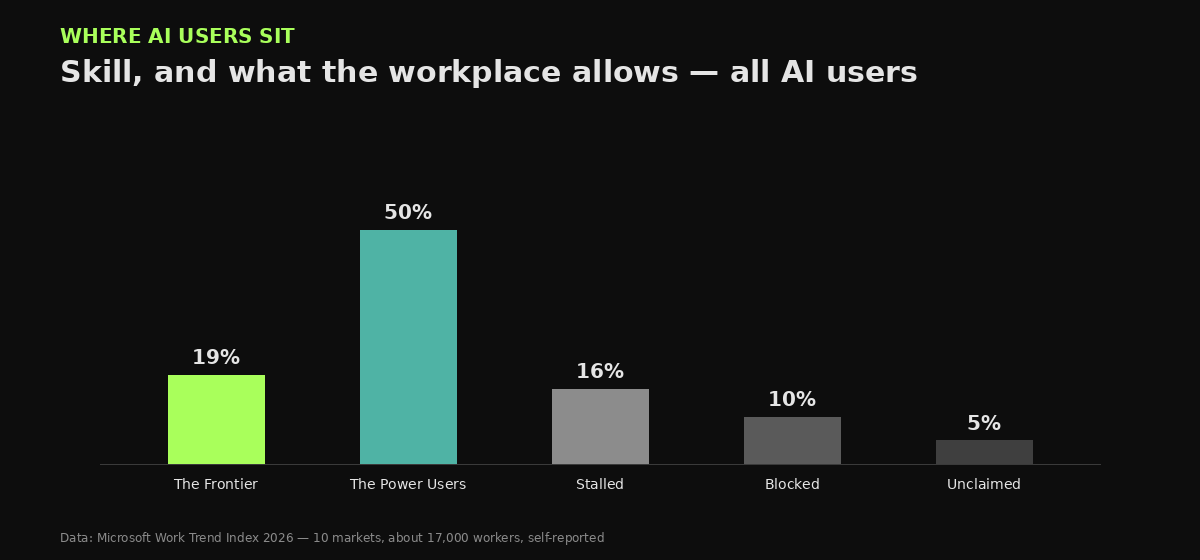
Data: Microsoft Work Trend Index 2026 — 10 markets, about 17,000 workers, self-reported.
That is the uncomfortable part of the hierarchy everyone is measuring themselves against. Much of it is permission.
The panic runs ahead
Two in three Americans say AI is moving too fast. Among the people who use it, most say they fear falling behind if they do not adapt, and the ones who are ahead are the one in five above. The comparison nobody can verify keeps running in private, unpaid, for months.
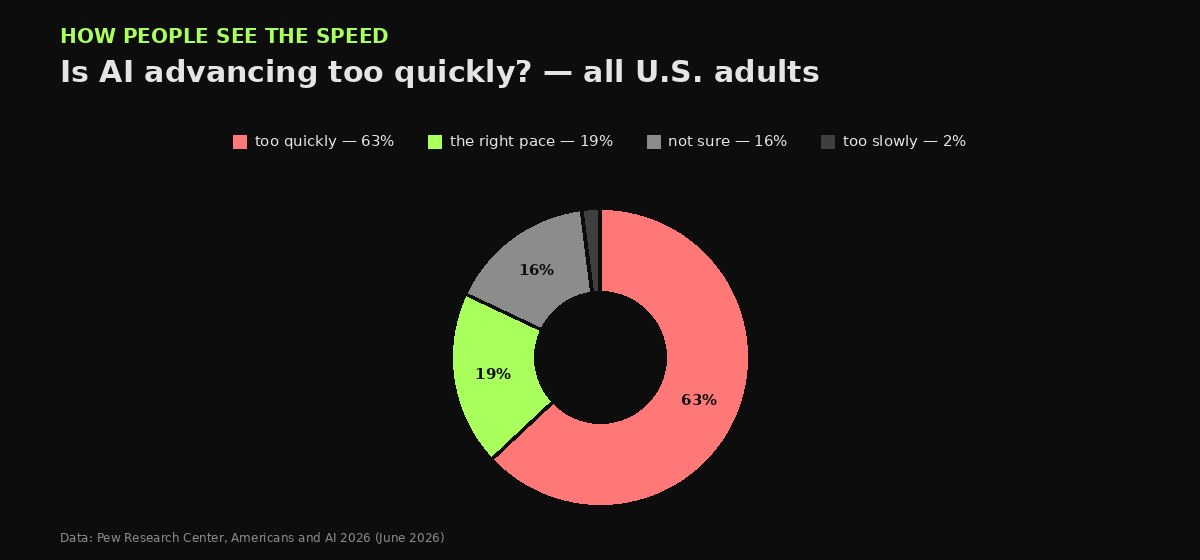
Data: Pew Research Center, “Americans and AI 2026” (June 2026).
Why the deeper users end up looking the same
Models get tuned toward the answers people rate as good. A tuned model does not hand you your taste; it hands you the average of the taste it was trained to hit. Ask for a recommendation and you get the same recommendation every other customer gets, from the same waiter.
A meta-analysis of 19 studies found that when people co-create with generative AI, their ideas, designs and texts become more alike — and that it bites hardest on tasks with tight constraints, where the model has a preferred answer ready. A study of close to a million texts found that letting a model polish your writing flattens a fifth to a half of the variation between writers. The meaning survives. The fingerprint does not.
You can see it in the street. The flyers are the clearest case: bright text on a dark background, rows of generic icons, arrows. Restaurant menus ran into the same wall, and Oxford’s Charles Spence measured the part I did not expect — diners rate AI food photos higher until they learn the photos are AI, and asked to make a dish look appetizing, the models add fat.
The part the data will not support
I want to be careful, because the tempting version of this post is that everyone has collapsed into the same person. The research does not say that. The effect is small, it depends on the task, and in open-ended work the spread holds. The fear is the bigger number, and it describes people who are not you.
Which leaves a better question than “am I behind”. What did I ask for today that had no default? My report got better when I told the model who was reading it; the template the next day did not have to make that decision.